

How Does Central Air Conditioning Work in New Orleans, and What Do Homeowners Need to Know?
- Licensed & Insured
- 24/7 Emergency Service
- Free Estimates
Meta Title: Central Air Conditioning in New Orleans | Big Easy Airconditioning
Meta Description: Everything New Orleans homeowners need to know about central air conditioning: how it works, system types, costs, efficiency, sizing, and maintenance. Slug: central-air-conditioning-new-orleans-complete-guide
How Does Central Air Conditioning Work in New Orleans, and What Do Homeowners Need to Know?
Central air conditioning in New Orleans uses a split-system or package unit to cool and dehumidify the entire home through a network of supply and return ducts. Because New Orleans’ subtropical climate demands near-continuous cooling from spring through fall, the system you choose, how it gets sized, and how often it gets maintained all directly determine your comfort and your monthly utility costs.
Central AC is not optional in New Orleans — it is infrastructure. Summers push heat index values above 100°F for weeks at a stretch, and indoor humidity without active cooling and dehumidification reaches levels that promote mold growth within days. Understanding how your central system works, what it costs to operate, and when it needs attention gives you control over one of the most significant expenses in your home.
Big Easy Air Conditioning has designed, installed, and serviced central air conditioning systems across the Greater New Orleans area for over a decade, serving homeowners in every neighborhood and parish.
How Does Central Air Conditioning Actually Work?
Central air conditioning works through a refrigeration cycle: the indoor evaporator coil absorbs heat and moisture from your home’s air, the refrigerant carries that heat to the outdoor condenser unit, and the condenser releases the heat outside. A blower fan circulates the cooled, dehumidified air through your duct system and back into the living spaces.
The key components in a standard split-system central AC:
- Compressor (outdoor unit): Pressurizes refrigerant, enabling the heat exchange cycle.
- Condenser coil (outdoor unit): Releases heat collected from inside the home to the outdoor air.
- Evaporator coil (indoor air handler): Absorbs heat and humidity from return air.
- Expansion valve: Regulates refrigerant flow and pressure between the indoor and outdoor components.
- Blower motor and air handler: Moves conditioned air through the duct system.
- Thermostat: Controls when the system runs and at what setpoints.
In New Orleans, the evaporator coil works especially hard because it must remove far more moisture from the air than it would in a drier climate. This is why dehumidification, not just temperature reduction, is the correct way to evaluate whether a central AC is performing.
What Types of Central AC Systems Are Available for New Orleans Homes?
The three most common central AC configurations in New Orleans are: split-system central air conditioners, heat pump systems, and package units. The right choice depends on your existing ductwork, home structure, and whether you need combined heating and cooling.
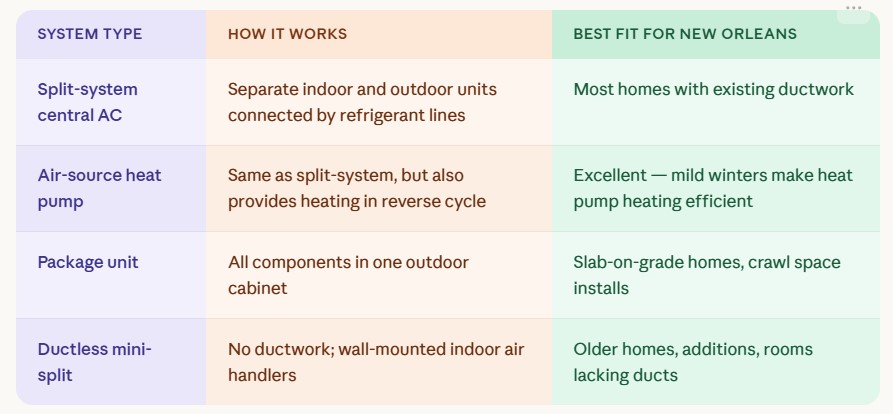
For homes without ductwork or with older duct systems in poor condition, ductless mini-split systems offer an efficient alternative. For most homes that already have ducts, a central split system remains the most practical choice.
If you are unsure which configuration fits your home, tips for choosing the right AC system and understanding the different types of AC units provide additional context.
How Is a Central AC System Sized for a New Orleans Home?
Central AC is sized using Manual J load calculations, an ACCA (Air Conditioning Contractors of America) standard that accounts for square footage, ceiling height, window area and orientation, insulation levels, local climate data, and occupancy. In New Orleans, the high design temperature and extreme latent (humidity) load mean systems are often sized slightly differently than in other regions.
Getting sizing right is especially important locally:
- An undersized system runs constantly and still cannot reach setpoint on hot days, while humidity remains too high.
- An oversized system cools too quickly, short cycles, and fails to run long enough to remove humidity from the air. In New Orleans, this means the home feels cold but clammy — a classic sign of an oversized unit.
One ton of cooling equals 12,000 BTU per hour. Most New Orleans homes require between 2 and 5 tons depending on size and construction. The guide to choosing the right size AC unit explains the Manual J process in plain terms.
Never allow a contractor to size your new system by simply matching the old unit’s tonnage. The old system may have been incorrectly sized, and a Manual J calculation adds little cost while guaranteeing the right outcome.
What Does Central Air Conditioning Cost to Install and Operate in New Orleans?
A new central AC installation in New Orleans typically costs $4,000 to $9,000 for a standard split-system replacement, depending on system size, efficiency rating, and ductwork condition. Annual operating costs depend on system efficiency, home size, and utility rates — but New Orleans homeowners typically spend more on cooling than the national average due to the long season.
Installation Cost Factors
- System tonnage (larger systems cost more)
- SEER2 efficiency rating (higher efficiency = higher upfront cost, lower operating cost)
- Ductwork condition and modifications required
- Equipment brand and warranty terms
- Permit fees (required in Orleans Parish and most surrounding parishes)
Operating Cost Reality
According to the U.S. Energy Information Administration (EIA), Louisiana consistently ranks among the lowest-cost states for residential electricity, with Entergy New Orleans charging approximately 12 to 13 cents per kWh for residential customers in 2024-2025. However, the sheer volume of cooling hours New Orleans demands means annual cooling costs for a typical 2,000 square foot home can run $1,400 to $2,200 per year. A modern, properly sized, high-efficiency system significantly reduces that figure compared to an aging 13 SEER unit.
Investing in good home insulation reduces how hard the central system has to work, which directly lowers both energy costs and equipment wear.
How Do Ducts Affect Central AC Performance in New Orleans?
Leaky or poorly insulated ducts can waste 20 to 30 percent of the air your central AC produces before it ever reaches the living spaces, according to the U.S. Department of Energy. In New Orleans, duct leakage is compounded by attic temperatures that regularly reach 140°F to 160°F in summer, cooking any supply air that passes through uninsulated ductwork.
Signs of duct problems include:
- Uneven cooling across rooms with no obvious airflow obstructions
- Stuffy or dusty rooms despite filter changes
- Higher-than-expected utility bills, even with a new, efficient system
- Humidity control problems in specific areas of the home
Flex duct systems common in many New Orleans homes from the 1990s and 2000s often develop sags, kinks, and connection failures over time. An AC duct services inspection should be part of any central AC replacement project.
What Maintenance Does a Central AC System Need in New Orleans?
A New Orleans central AC system needs monthly air filter changes, quarterly condensate drain flushes, and at minimum one professional tune-up per year scheduled in early spring. Because the system operates far more hours per year than in cooler climates, annual maintenance is not optional — it is the difference between a 15-year system lifespan and a 10-year one.
The condensate drain deserves special attention. In New Orleans’ humidity, drain lines develop algae blockages within weeks of the cooling season starting. A clogged drain causes the drain pan to overflow, potentially causing significant water damage to ceilings, walls, and flooring. A quarterly flush with white vinegar or diluted bleach prevents this almost entirely.
For the complete maintenance schedule, review AC maintenance tips for New Orleans homeowners and how to extend the life of your AC unit.
Frequently Asked Questions
What is the best central AC brand for New Orleans?
Brands with strong Gulf South distribution networks and good parts availability — including Carrier, Trane, Lennox, Rheem, and Goodman — all perform well when properly sized and installed. Reliability in New Orleans’ climate depends more on correct sizing, quality installation, and regular maintenance than brand name alone.
How long does central AC last in New Orleans?
Most central air conditioners last 15 to 20 years with proper maintenance. New Orleans’ demanding climate can push systems toward the lower end of that range without consistent care. Systems that receive annual tune-ups, monthly filter changes, and quarterly drain service reliably approach the 20-year mark.
Is central AC more efficient than window units for a whole home?
Yes, significantly. A properly sized and installed central AC system delivers far better whole-home dehumidification and more consistent temperatures than multiple window units. Window units also introduce air infiltration around the unit, reducing overall energy efficiency.
Can central AC improve indoor air quality?
Yes, through filtration, dehumidification, and air circulation. A central system with a quality MERV 8 to MERV 11 filter removes pollen, dust, and pet dander from circulating air. Keeping humidity below 55 percent also suppresses mold and dust mite populations, both of which are significant indoor air quality concerns in New Orleans. Learn more about improving indoor air quality with your AC unit.
What SEER2 rating should I choose for a New Orleans home?
The DOE minimum for Louisiana (Southeast region) is 14.3 SEER2 for systems under 45,000 BTU. Choosing a system rated 17 to 20 SEER2 adds upfront cost but reduces operating costs meaningfully over a 15-year lifespan in a high-use climate like New Orleans.
Does a smart thermostat help with central AC performance?
Yes. A smart thermostat improves efficiency by learning usage patterns, enabling precise scheduling, and allowing remote adjustments. In New Orleans, where temperatures can vary significantly from morning to afternoon, a programmable or smart thermostat prevents unnecessary cooling during lower-demand hours. Read about the advantages of upgrading to a smart thermostat for a full breakdown.
Get Expert Central AC Help in New Orleans
Central air conditioning in New Orleans is not a simple plug-and-play purchase. The right system size, efficiency level, duct condition, and installation quality all determine whether your home stays comfortable and your energy bills stay manageable for the next 15 to 20 years.
Big Easy Air Conditioning is New Orleans’ trusted licensed and insured central AC specialist, with 10-plus years of local experience and a team that understands what this climate demands from a cooling system.
Contact Big Easy Air Conditioning today for a free estimate on central AC installation, replacement, or service.
Last Updated: March 2026
JSON-LD Schema Markup
<script type=”application/ld+json”>
{
“@context”: “https://schema.org”,
“@graph”: [
{
“@type”: “BlogPosting”,
“headline”: “Central Air Conditioning in New Orleans: Complete Guide”,
“description”: “Everything New Orleans homeowners need to know about central air conditioning: how it works, system types, costs, efficiency, sizing, and maintenance.”,
“url”: “https://www.bigeasyairconditioning.com/central-air-conditioning-new-orleans-complete-guide/”,
“datePublished”: “2026-03-17”,
“dateModified”: “2026-03-17”,
“author”: {
“@type”: “Organization”,
“name”: “Big Easy Air Conditioning”,
“url”: “https://www.bigeasyairconditioning.com/”
},
“publisher”: {
“@type”: “Organization”,
“name”: “Big Easy Air Conditioning”,
“logo”: {
“@type”: “ImageObject”,
“url”: “https://www.bigeasyairconditioning.com/wp-content/uploads/2023/03/logo.png”
},
“url”: “https://www.bigeasyairconditioning.com/”,
“telephone”: “504-636-8724”,
“address”: {
“@type”: “PostalAddress”,
“addressLocality”: “New Orleans”,
“addressRegion”: “LA”,
“addressCountry”: “US”
},
“sameAs”: [
“https://www.facebook.com/BigEasyAirConditioning/”,
“https://www.instagram.com/bigeasyairconditioning/”,
“https://x.com/BEAConditioning”,
“https://www.youtube.com/@BigEasyAirConditioning”
]
},
“hasPart”: {
“@type”: “FAQPage”,
“mainEntity”: [
{
“@type”: “Question”,
“name”: “What is the best central AC brand for New Orleans?”,
“acceptedAnswer”: {
“@type”: “Answer”,
“text”: “Brands with strong Gulf South distribution networks — including Carrier, Trane, Lennox, Rheem, and Goodman — all perform well when properly sized and installed. Reliability in New Orleans’ climate depends more on correct sizing, quality installation, and regular maintenance than brand name alone.”
}
},
{
“@type”: “Question”,
“name”: “How long does central AC last in New Orleans?”,
“acceptedAnswer”: {
“@type”: “Answer”,
“text”: “Most central air conditioners last 15 to 20 years with proper maintenance. New Orleans’ demanding climate can push systems toward the lower end of that range without consistent care. Systems that receive annual tune-ups, monthly filter changes, and quarterly drain service reliably approach the 20-year mark.”
}
},
{
“@type”: “Question”,
“name”: “Is central AC more efficient than window units for a whole home?”,
“acceptedAnswer”: {
“@type”: “Answer”,
“text”: “Yes, significantly. A properly sized and installed central AC system delivers far better whole-home dehumidification and more consistent temperatures than multiple window units. Window units also introduce air infiltration, reducing overall energy efficiency.”
}
},
{
“@type”: “Question”,
“name”: “Can central AC improve indoor air quality?”,
“acceptedAnswer”: {
“@type”: “Answer”,
“text”: “Yes, through filtration, dehumidification, and air circulation. A central system with a quality MERV 8 to MERV 11 filter removes pollen, dust, and pet dander. Keeping humidity below 55 percent also suppresses mold and dust mite populations, which are significant indoor air quality concerns in New Orleans.”
}
},
{
“@type”: “Question”,
“name”: “What SEER2 rating should I choose for a New Orleans home?”,
“acceptedAnswer”: {
“@type”: “Answer”,
“text”: “The DOE minimum for Louisiana (Southeast region) is 14.3 SEER2 for systems under 45,000 BTU. Choosing a system rated 17 to 20 SEER2 adds upfront cost but reduces operating costs meaningfully over a 15-year lifespan in a high-use climate like New Orleans.”
}
},
{
“@type”: “Question”,
“name”: “Does a smart thermostat help with central AC performance?”,
“acceptedAnswer”: {
“@type”: “Answer”,
“text”: “Yes. A smart thermostat improves efficiency by learning usage patterns, enabling precise scheduling, and allowing remote adjustments. In New Orleans, where temperatures vary significantly from morning to afternoon, a programmable or smart thermostat prevents unnecessary cooling during lower-demand hours.”
}
}
]
}
},
{
“@type”: “BreadcrumbList”,
“itemListElement”: [
{ “@type”: “ListItem”, “position”: 1, “name”: “Home”, “item”: “https://www.bigeasyairconditioning.com/” },
{ “@type”: “ListItem”, “position”: 2, “name”: “Blog”, “item”: “https://www.bigeasyairconditioning.com/blog/” },
{ “@type”: “ListItem”, “position”: 3, “name”: “Central Air Conditioning in New Orleans: Complete Guide”, “item”: “https://www.bigeasyairconditioning.com/central-air-conditioning-new-orleans-complete-guide/” }
]
}
]
}
</script>