

When Should a New Orleans Homeowner Replace Their AC Instead of Repairing It?
- Licensed & Insured
- 24/7 Emergency Service
- Free Estimates
Meta Title: When to Replace Your AC: New Orleans Guide | Big Easy Airconditioning
Meta Description: Not sure if your AC needs repair or replacement? New Orleans homeowners guide to age, efficiency signs, repair costs, and choosing the right new system.
Slug: when-to-replace-ac-new-orleans-homeowners-guide
When Should a New Orleans Homeowner Replace Their AC Instead of Repairing It?
A New Orleans homeowner should replace their AC when the system is 15 or more years old, uses R-22 refrigerant, requires a repair costing more than half the price of a new unit, or consistently fails to control humidity. In New Orleans’ extreme heat and humidity, an aging or inefficient system costs significantly more to operate and repair than a modern replacement.
The decision between repair and replacement is rarely black and white. But in a climate where air conditioning is not a seasonal convenience—it is a year-round necessity—holding onto the wrong system past its useful life costs real money every month in elevated utility bills, repeated repair visits, and comfort problems that a new unit would have solved on day one.
Big Easy Air Conditioning helps New Orleans homeowners evaluate aging systems and make the right call. Free estimates take the guesswork out of the decision.
How Old Is Too Old for a New Orleans AC?
An AC system older than 15 years in New Orleans should be evaluated seriously for replacement, not just repaired. While the national average lifespan for a central air conditioner is 15 to 20 years, New Orleans’ climate — with its long operating seasons, high humidity, and salt air — frequently pushes systems to the lower end of that range.
Age alone does not always mean replacement is urgent, but age combined with any of the following factors tips the scale firmly toward replacement:
- The system runs on R-22 refrigerant, which the EPA banned from production as of January 2020
- Repair costs for a single issue exceed $1,500
- Monthly utility bills have climbed without any change in usage habits
- The system short cycles, runs constantly, or struggles to reach setpoint on hot afternoons
- Humidity inside the home feels uncomfortable even when the thermostat is satisfied
A 15-year-old system in New Orleans has already operated two to three times as many hours as the same unit would have logged in Chicago or Minneapolis. Those are real miles on the compressor, capacitors, fan motors, and heat exchangers.
What Is the Best Way to Decide Between Repair and Replacement?
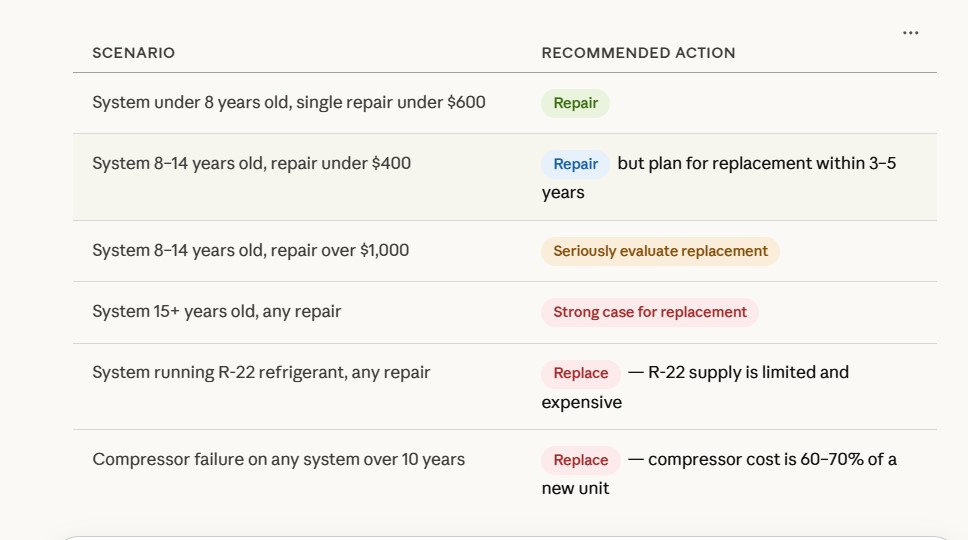
The most reliable framework is the “$5,000 Rule”: multiply the system’s age (in years) by the estimated repair cost. If the result exceeds $5,000, replacement typically delivers better long-term value. A 14-year-old unit needing a $500 capacitor replacement scores 7,000 — strong grounds for replacement planning.
This rule is a guideline, not a law. Here is how to apply it alongside other factors:
What Are the Warning Signs That Replacement Is Overdue?
The clearest replacement warning signs are: a system that can no longer maintain indoor humidity below 55 percent, utility bills that have increased 20 percent or more without explanation, repeated repair calls within a single season, and a system operating on phased-out R-22 refrigerant.
Watch for these specific red flags:
- Humidity problems: In New Orleans, an AC that cools but cannot dehumidify has lost the ability to perform its most critical function. High indoor humidity enables mold growth and makes the air feel much warmer than the thermostat reading.
- Short cycling: A system that turns on and off every few minutes without completing a full cooling cycle either has a refrigerant problem or has become oversized relative to the home’s actual load.
- Rising energy bills: The U.S. Department of Energy notes that an AC system loses roughly 5 percent efficiency for every year it goes without proper maintenance. A 15-year-old neglected system may be operating at 60 to 70 percent of its original efficiency rating.
- Uneven cooling: Hot rooms despite open vents typically signal duct leakage, failing equipment, or a unit that has lost capacity.
- Frequent repairs: Two or more repair calls in a single season is a strong signal that the system is in the end-stage of its useful life.
Also review common AC problems and how to fix them to separate one-time failures from patterns that indicate a dying system.
What Are the Financial Benefits of Replacing an Old AC in New Orleans?
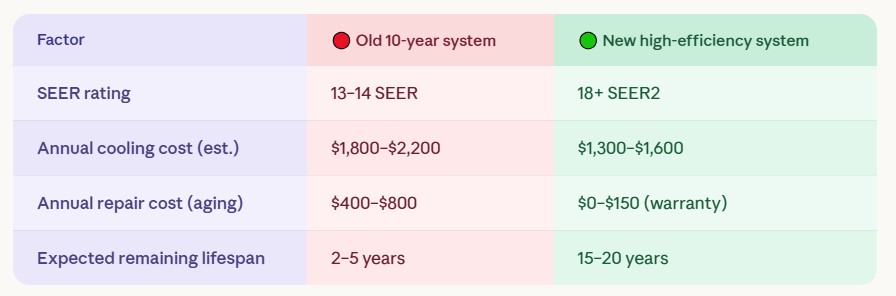
Replacing a 15 SEER system from 2010 with a modern 18 SEER2-rated unit can reduce cooling energy costs by 16 to 20 percent annually. In New Orleans, where AC accounts for a large share of the electricity bill for seven or more months per year, those savings compounds significantly over the life of the new system.
Here is a straightforward cost comparison:
Beyond operating costs, modern systems also offer better humidity control, quieter operation, improved indoor air quality, and compatibility with smart thermostats. Learn more about the benefits of investing in a high-efficiency AC unit to see the full picture.
Also, federal tax credits available through 2025 under the Inflation Reduction Act allow homeowners to claim up to $600 for a qualifying central air conditioner replacement. Heat pump replacements may qualify for up to $2,000.
What System Should You Buy When Replacing Your AC in New Orleans?
For most New Orleans homes with existing ductwork, a split-system central air conditioner rated at 16 SEER2 or higher is the standard replacement choice. Homes without ducts, additions, or rooms with comfort problems are strong candidates for a ductless mini-split system.
Key factors in choosing a replacement system:
- Sizing: Always requires a Manual J load calculation. Do not let any contractor size the replacement based on matching the old unit’s tonnage alone — that tonnage may have been wrong to begin with.
- SEER2 rating: The DOE minimum for Louisiana is 14.3 SEER2 for systems under 45,000 BTU. Stepping up to 17 to 20 SEER2 provides meaningful long-term savings in New Orleans’ climate.
- Brand reliability: Brands with strong dealer support networks and parts availability in the Gulf South region matter more than national brand rankings. Read the top AC brands for New Orleans homes before committing.
- Ductwork condition: If existing ducts are leaky or poorly insulated, a new high-efficiency unit installed in a bad duct system will underperform. Address the ducts at the same time as the equipment.
Frequently Asked Questions
How long do AC units last in New Orleans?
Most central air conditioners last 15 to 20 years nationally, but New Orleans’ long operating season, high humidity, and salt air often push systems to the lower end of that range. Systems that receive regular maintenance consistently last longer.
Is it worth repairing a 12-year-old AC?
It depends on the repair cost and the system’s condition. A minor repair like a capacitor or contactor replacement on a well-maintained 12-year-old system is usually worth it. A compressor replacement or refrigerant leak repair on the same system is often not — at that point, replacement economics typically win.
What happens when an AC runs R-22 refrigerant and needs a recharge?
R-22 is no longer produced or imported in the U.S. as of January 2020. Recharging an R-22 system depends on limited reclaimed stock, which makes it expensive and unreliable. Most HVAC contractors recommend replacement rather than investing in refrigerant for an aging R-22 system.
What is the cheapest way to replace an AC in New Orleans?
Getting three competitive estimates from licensed HVAC contractors is the starting point. Many contractors offer financing options. Also check for manufacturer rebates, utility company rebates through Entergy Louisiana, and federal tax credits that can offset upfront costs significantly.
How much does it cost to replace an AC in New Orleans?
Central AC replacement in New Orleans typically runs $4,000 to $9,000 depending on system size, efficiency rating, and whether ductwork modifications are needed. A full system replacement including air handler and outdoor condenser at the higher end of SEER2 ratings sits closer to the upper range.
Can I replace just the outdoor unit and keep the old air handler?
Sometimes, but it requires careful compatibility verification. Mixing mismatched equipment generations or refrigerant types can reduce efficiency, void warranties, and cause premature failures. A licensed technician must confirm compatibility before a split replacement is done.
Should I replace my AC before it fails completely?
Yes, if the system is over 15 years old and showing performance decline. Proactive replacement lets you shop on your timeline, choose the right system, and schedule installation before summer. Emergency replacements in July often mean limited equipment availability and premium pricing.
Make the Right Call on Your AC Replacement
Reach out to Big Easy Air Conditioning today and get a clear answer on whether your system is worth keeping.