

Central AC vs. Ductless Mini-Split: Which Is Better for New Orleans?
Central AC works best for whole-home cooling in New Orleans, while ductless mini-splits are the stronger choice for zone control, room additions, and homes without existing ductwork. Both systems handle the city’s intense humidity when equipped with variable-speed compressors. The right pick depends on the home’s layout, ductwork condition, and cooling priorities.
How Does Central AC Compare to a Ductless Mini-Split?
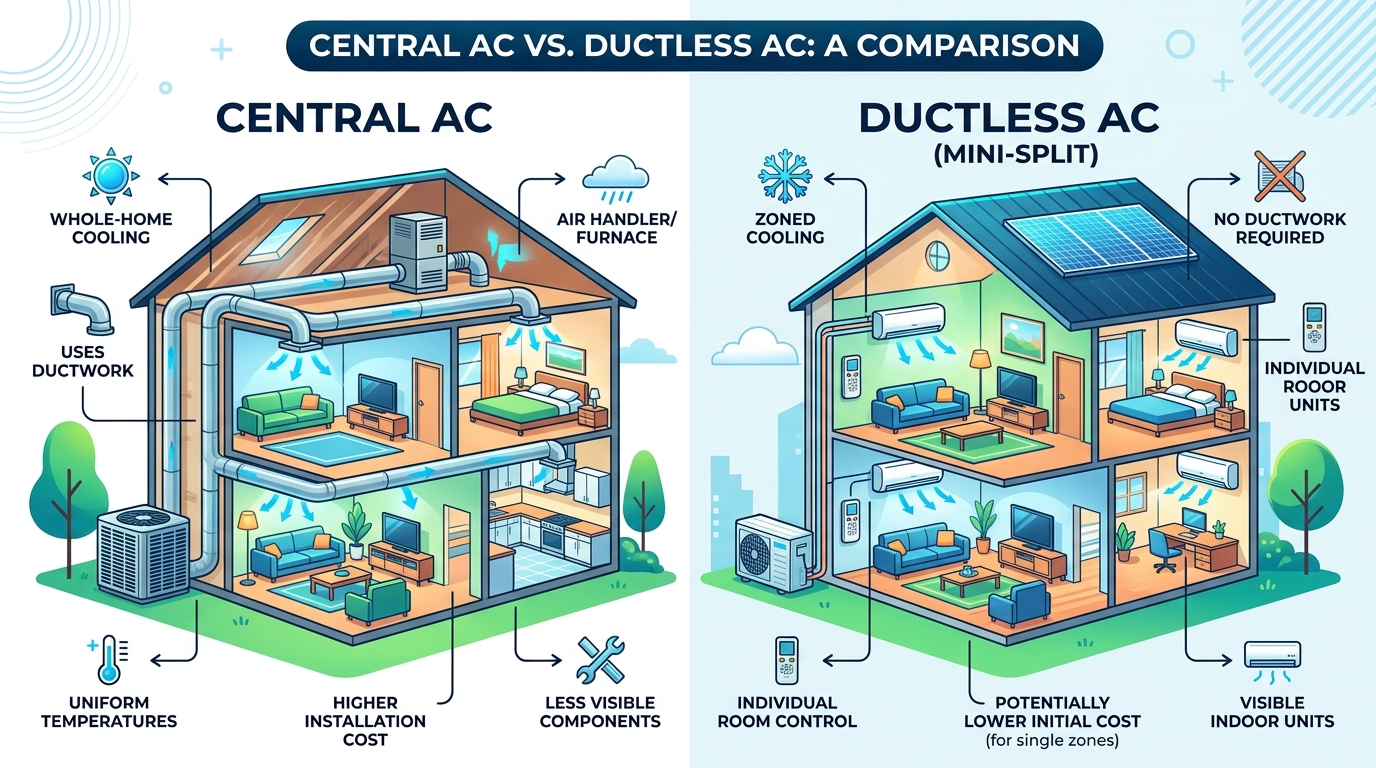
The two systems take fundamentally different approaches to cooling a home.
Central AC uses a single outdoor condenser, an indoor air handler, and a network of ducts to distribute cooled air through every room. One thermostat controls the entire system. This setup works well for homes that already have ductwork in place.
Ductless mini-splits pair an outdoor condenser with one or more wall-mounted indoor units. Each indoor unit cools its own zone independently with its own thermostat. No ductwork is needed — just a small hole through the wall for refrigerant lines.
Here’s a side-by-side breakdown:
| Feature | Central AC | Ductless Mini-Split |
|---|---|---|
| Best For | Whole-home cooling | Zone cooling, additions, older homes |
| Installation Time | 1-5 days | 3-8 hours per zone |
| SEER2 Range | 14-28 | 16-42 |
| Upfront Cost (installed) | $3,500-$10,000 | $2,000-$5,000 per zone |
| Humidity Control | Excellent (whole-home) | Excellent (per zone) |
| Noise (indoor) | 50-70 dB | 19-32 dB |
| Ductwork Required | Yes | No |
| Lifespan | 15-20 years | 15-25 years |
Homeowners looking at the top AC brands available in New Orleans will find both system types offered by major manufacturers like Trane, Carrier, and Mitsubishi.
Which System Handles New Orleans Humidity Better?

New Orleans sees average humidity levels above 75% for much of the year. Both system types can manage this — the compressor technology matters more than the system type.
Central AC with a variable-speed compressor runs at lower capacity for longer periods, pulling moisture from the air across the entire home. This works well for consistent dehumidification in every room.
Mini-splits with inverter-driven compressors do the same thing on a per-zone basis. They run continuously at low power rather than cycling on and off. Each indoor unit independently targets its zone’s humidity level.
The key difference: central AC dehumidifies uniformly through the duct system, while mini-splits may leave unserved areas (hallways, closets) with higher humidity. Homeowners who want to understand this dynamic in more detail can read about the impact of humidity on AC units.
What Are the Cost Differences?
Upfront and long-term costs vary significantly.
Central AC installation for a 2,000 sq ft New Orleans home typically runs $4,500-$8,000 when replacing an existing system. New installations requiring ductwork push the total to $7,000-$15,000.
Ductless mini-split installation costs $2,000-$5,000 per zone. A single zone for one room is affordable, but a 4-zone system to cover a whole house reaches $8,000-$20,000 — potentially more than central AC.
Operating costs favor mini-splits slightly. Their higher SEER2 ratings (up to 42 for premium models) and zone-based cooling mean homeowners only cool occupied rooms. ENERGY STAR estimates that ductless systems can cut cooling costs by 25-30% compared to central AC when used for zone cooling.
However, central AC wins on cost-per-square-foot for whole-home cooling when ductwork already exists. Investing in high-efficiency AC units narrows the operating cost gap further.
When Should Homeowners Choose Central AC?
Central AC is the better fit when:
- The home already has ductwork. Using existing ducts keeps installation costs lower and timelines shorter.
- Whole-home cooling is the priority. A single system cools every room evenly.
- Resale value matters. Buyers in the New Orleans market expect central AC. Homes without it may sit longer on the market.
- The homeowner prefers hidden equipment. Ducts and vents sit behind walls and ceilings. Nothing mounts on the wall.
Proper ductwork maintenance and insulation are required to maximize central AC efficiency in the Louisiana heat.
When Should Homeowners Choose a Ductless Mini-Split?
Mini-splits make more sense when:
- No ductwork exists. Older New Orleans homes, historic properties, and converted buildings often lack ducts entirely. Installing ductwork costs $3,000-$7,000 on top of the AC unit.
- Room additions need cooling. A sunroom, garage conversion, or attic bedroom gets its own zone without extending the central system.
- Zone control saves energy. Cooling only the rooms in use reduces waste. The advantages of zoning an AC system apply strongly to mini-splits.
- Quiet operation is a priority. Indoor units at 19-32 decibels are whisper-quiet compared to central AC air handlers.
Many New Orleans homeowners also use a hybrid approach — central AC for the main living areas and a mini-split for a problem room. Read more about why ductless systems are ideal for small spaces or review the pros and cons of ductless AC systems.
Contact Big Easy Air Conditioning for a free in-home assessment to determine which system — or combination — fits the home best.
FAQ
Is a mini-split cheaper than central AC?
A single-zone mini-split costs $2,000-$5,000 installed, while central AC runs $3,500-$10,000. Multi-zone mini-splits can match or exceed central AC costs.
Can a mini-split cool a whole house?
Yes, but it requires multiple indoor units. A multi-zone system with 3-5 heads handles most homes, though upfront costs increase with each zone.
Which system handles New Orleans humidity better?
Both handle humidity well with variable-speed compressors. Central AC with proper ductwork provides more consistent whole-home dehumidification.
Do mini-splits need maintenance?
Yes. Mini-splits need filter cleaning every 2-4 weeks and professional service once a year, similar to central AC maintenance schedules.
How long do central AC and mini-split systems last?
Central AC systems last 15-20 years on average. Mini-splits last 15-25 years since they have fewer mechanical components and no ductwork degradation.
Which system is quieter?
Mini-split indoor units run at 19-32 decibels, quieter than most central AC systems at 50-70 decibels. Both have quiet outdoor units.
Can mini-splits and central AC work together?
Yes. Many New Orleans homeowners add a mini-split to supplement central AC in problem areas like sunrooms, garages, or additions.
Last updated: April 2, 2026